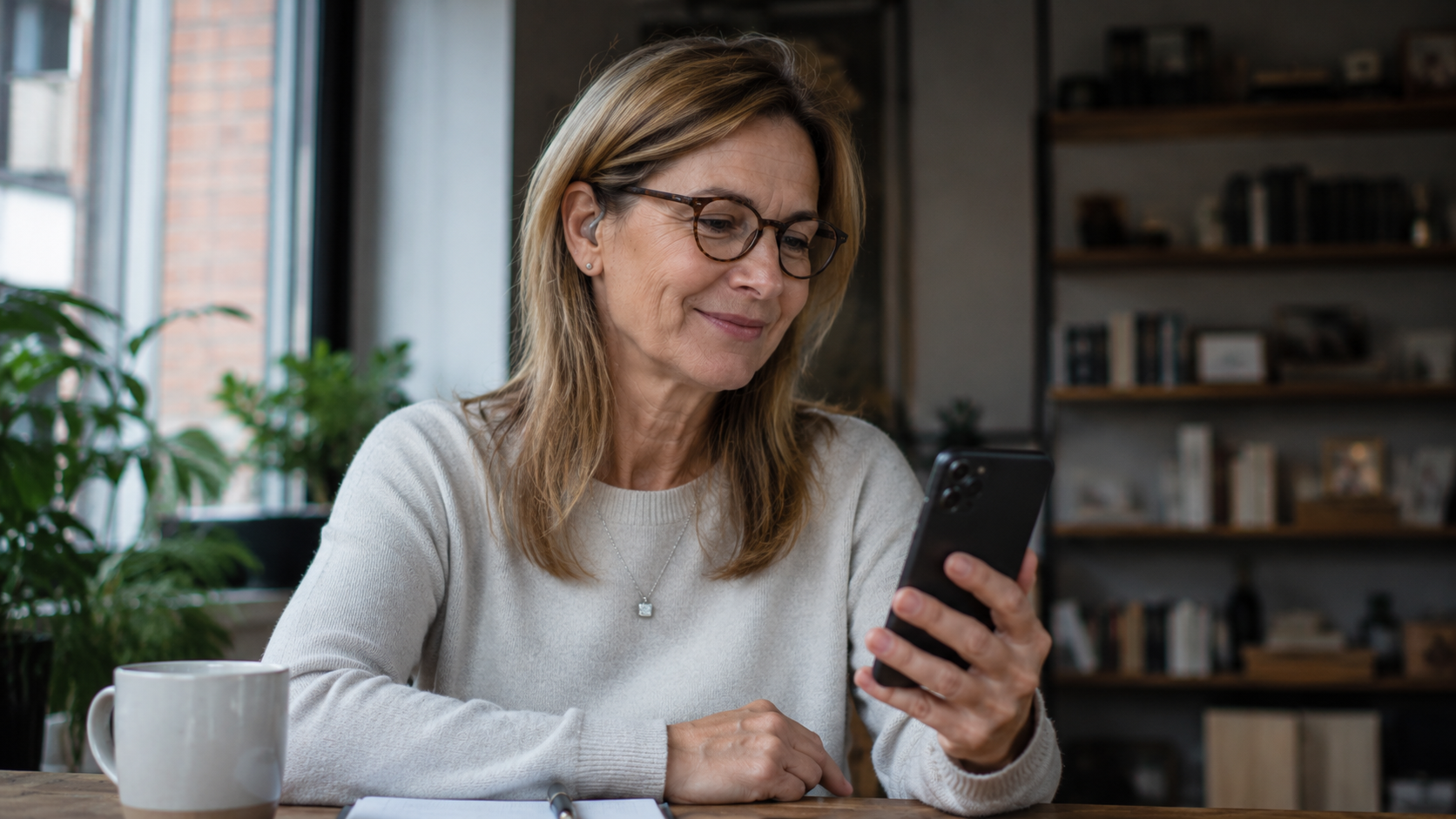
Helen took a call between meetings last Tuesday. She handled it. She also didn’t hear most of it. Thankfully the captions were running.
About 50 million Americans live with some degree of hearing loss (HLAA). For a lot of them, that’s how phone calls work now.
A group that size doesn’t need a “better hearing” project, it needs tools that fit. The name change finally reflects that.
When did Better Hearing Month start?
Better Hearing and Speech Month has run every May since 1927, organized by the American Speech-Language-Hearing Association (ASHA).
Key dates:
- 1925: ASHA founded
- 1927: May designated for hearing and speech awareness
- 2007: FCC launches IP Captioned Telephone Service program
- 2010: 21st Century Communications and Video Accessibility Act signed into law
- 2024: ASHA renames May to National Speech-Language-Hearing Month
“Better hearing” framed hearing as the target and hearing loss as the gap to close. NSLHM drops that premise. The point is communication, not correction. Hearing aids, cochlear implants, sign language, captioning, and video relay are all on equal footing as legitimate ways to communicate. Signing is communicating. Captioning is communicating. They aren’t degraded versions of speech, they’re full modes in their own right.
Olivier Jeannel, deaf since age 2, has been making this case for years. He founded Rogervoice, a captioned calling app, on exactly this idea: “People aren’t yet used to the notion that captioning is now possible on phone calls. My ambition is to get to the point where the average Jane is no more surprised at captions on the phone than they are at captions on TV.”
For captioned calling specifically, this matters: it validates it as a full communication mode, not a crutch for people who can’t use the “real” phone.
What hearing technology exists in 2026?
For people who use their residual hearing, the device side has moved fast. Modern hearing aids stream audio over Bluetooth directly from phones, TVs, and laptops, with AI noise reduction that adapts to the room. Over-the-counter hearing aids have been available without a prescription or audiologist visit since 2022, which dropped the price floor significantly. Cochlear implants and bone conduction devices continue to expand use cases to more people, including for single-sided deafness.
None of these replace each other. A hearing aid at home, captions on a work call, ASL with friends, it all counts as communication. That’s exactly the point of the new NSLHM framing.
What captioning and relay technology exists in 2026?
A decade ago, captioned calling meant a dedicated landline handset and a human transcriber on the other end. In 2026, it’s an app on the phone you already own. Live captions run on mobile calls, wherever you go. Real-time text is rolling out across U.S. carriers as the successor to TTY. ASL video relay is available 24/7. Captioned video conferencing with speaker identification is standard across major platforms such as Zoom, Teams, and Meet.
Most of these tools were designed from outside the community. Rogervoice is one of the exceptions. Olivier, who is deaf, built it because he wanted something different. “It had to be cool,” he says. “I was tired of ‘disability technology’ looking so medical. Prescription glasses are made by talented designers.” He wanted the same design care for the apps deaf and hard of hearing people use.
The shift
For nearly a century, May was the month we tried to fix hearing. In 2026, it’s the month built around how people actually communicate.
Helen will take another call tomorrow. She won’t necessarily think about which month it is. The captions will just run, and that’s what matters.
Rogervoice is free for deaf and hard of hearing users in the U.S., FCC-certified, and available on iOS and Android.
Frequently asked questions
Is captioned calling free in the U.S.?
If you’re deaf or hard of hearing and use an FCC-certified provider, yes. The Federal Telecommunications Relay Service program funds IP Captioned Telephone Services (IP CTS), so certified providers like Rogervoice offer it at no cost to eligible users. Non-certified captioning apps may charge or use different funding models.
Do I need a special phone for captioned calling?
No. Captioned calling runs as an app on the smartphone you already have. You keep your existing phone number, and with apps like Rogervoice, incoming calls get forwarded to the app so callers see no difference on their end. If you prefer a traditional handset at home, dedicated captioned home phones are still available as well. Both routes are covered under FCC IP CTS.
What’s the difference between Better Hearing and Speech Month and National Speech-Language-Hearing Month?
They’re the same May observance. ASHA renamed it in 2024 to reflect a broader focus on communication, not just hearing.
How accurate are real-time captions in 2026?
Very. Modern AI captioning handles everyday conversation reliably, including most accents and natural speech patterns. Performance is strongest in good audio conditions and one-on-one calls. Heavy background noise, multiple overlapping speakers, or highly technical jargon can still trip it up, but the gap between captioned and unaided conversation has narrowed dramatically over the last few years.
Who certifies captioned calling providers?
The Federal Communications Commission certifies providers under the IP CTS program. Rogervoice is FCC-certified for U.S. citizens to use.
Are captioned phone calls private?
For ASR-based IP CTS calls and on-device transcripts, yes. Some captioned calling services route calls through human captioners who hear your conversation in real time, while others use fully automated AI captioning with no human in the loop (ASR stands for automatic speech recognition). Rogervoice is fully automated, so no one else is on the line. Second, what happens to the transcript: with Rogervoice, transcripts are stored only on your own phone, so you can go back and check important details from a call (an appointment time, an address) without anyone else having access. Other providers store transcripts on their servers, some discard them. If privacy matters to you, check each provider’s policy for both the call itself and what’s retained afterward.
