You’re qualified. You have the resume, the skills, the references. But somewhere between the job posting and the offer letter, your hearing loss becomes the thing people focus on instead of the work you can actually do.
That gap between what deaf and hard-of-hearing workers can do and what employers assume they can do is real, but it is narrowing. Deaf professionals now hold roles in software engineering, law, medicine, education, government, and nearly every other field you can name. The legal protections exist. The tools exist. What’s often missing is a clear picture of both.
This guide covers the job market for deaf and hard-of-hearing job-seekers, the legal rights that protect you at work, the industries actively hiring, and the communication tools, including the ones built for phone calls, that make the daily work easier.
What the Job Market Actually Looks Like for Deaf and Hard-of-Hearing Workers
The employment gap is real, but it isn’t about ability. Federal labor data shows that people with a disability, a category that includes hearing difficulty, are employed at a lower rate than people without a disability. That’s relevant context for deaf and hard-of-hearing job seekers, though it shouldn’t be read as a hearing-specific statistic unless a hearing-specific dataset says so. Source: U.S. Bureau of Labor Statistics
Common barriers include:
- Employers defaulting to phone-based interviews and processes, with no alternative offered
- Assumptions about which roles a deaf or hard-of-hearing person “can” do, made before a single conversation happens
- Limited awareness that low-cost or no-cost accommodations exist, so companies overestimate the effort involved
None of these concern the work itself. Job opportunities for deaf people exist across nearly every industry. The barrier is usually the hiring process, not the job.
Your Rights Under the ADA (and How to Use Them)
The Americans with Disabilities Act (ADA) protects qualified job-seekers and employees who are deaf or hard of hearing from discrimination in hiring, promotion, and daily working conditions. Companies with 15 or more employees are covered. The U.S. Equal Employment Opportunity Commission enforces this law and explains it in plain language. Source: U.S. Equal Employment Opportunity Commission
In practice, that means you can request a reasonable accommodation at any stage, from the interview to your first year on the job:
- Tell the employer what you need. You usually don’t need to share a full diagnosis. In many cases, you can explain work-related barriers and any accommodations that would help. If the need isn’t obvious, an employer can ask for limited documentation.
- Suggest a specific accommodation if you have one in mind: an interpreter, real-time captioning, a written agenda before meetings, or a captioned phone line.
- Give the employer a reasonable amount of time to respond. They can propose an alternative, as long as it works just as well.
- Get the agreed accommodation in writing, even if it’s a short email confirming what was discussed.
- If a request is denied without a valid reason, the EEOC has a formal complaint process, and the National Association of the Deaf can point you toward local legal support. Source: National Association of the Deaf
Accommodations like these usually cost an employer little or nothing. That’s worth remembering the next time you feel like you’re asking for too much. You’re not.
This article is general information, not legal advice.
Job Opportunities for Deaf People: The Fields Already Hiring
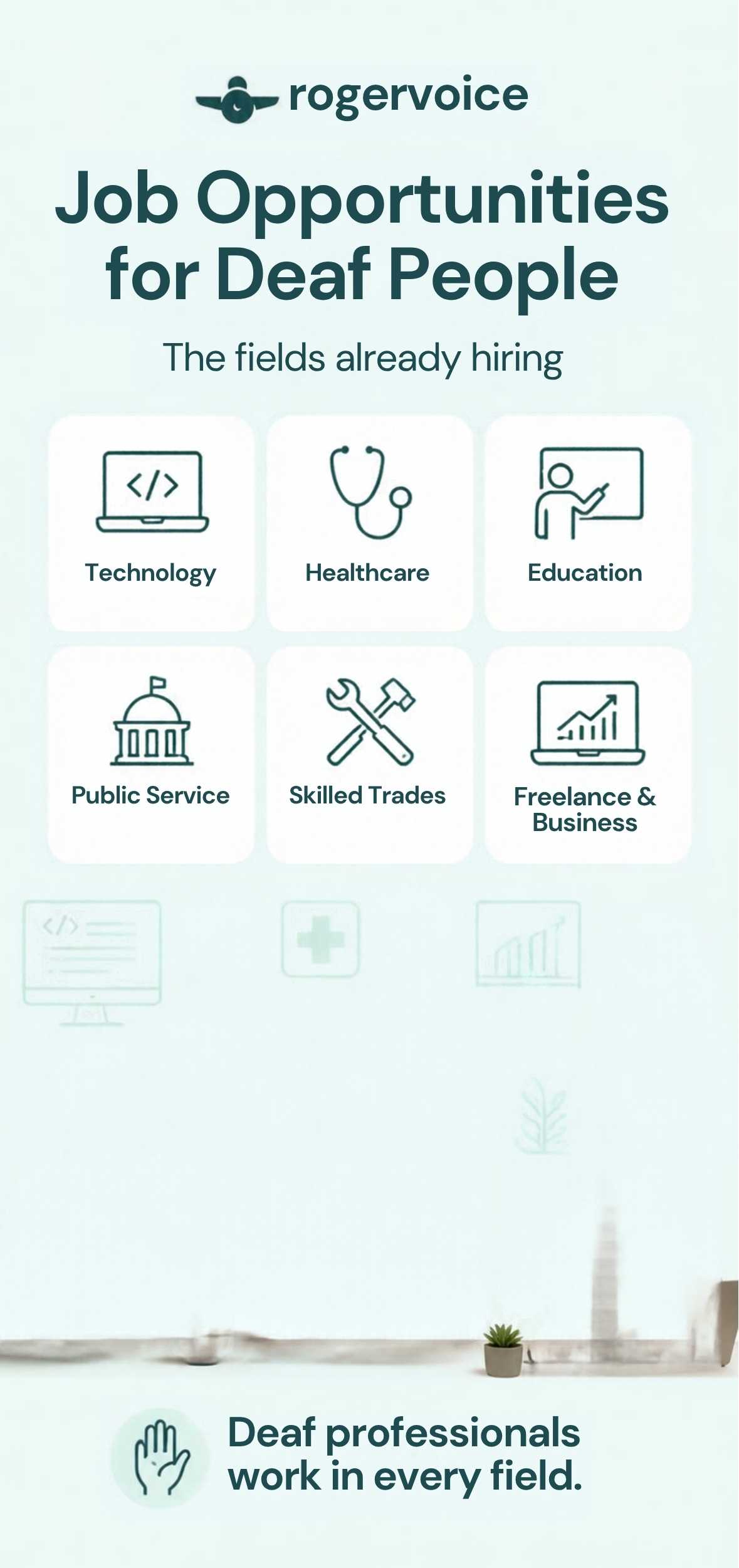
There’s no fixed list of “jobs for deaf people.” Deaf and hard-of-hearing professionals work as surgeons, software architects, teachers, electricians, lawyers, and chefs, and everything in between. More useful than a list of “safe” jobs is a look at where hiring is active and accommodations are already well established:
- Technology: Remote and hybrid roles in software, data, and product design often run on written communication (chat, email, documentation) by default, which naturally reduces phone dependency.
- Healthcare and public health: Hospitals and clinics increasingly staff interpreters and offer captioning services. oles in research, administration, and allied health are growing.
- Education: From classroom teaching to instructional design, schools serving deaf and hard-of-hearing students actively seek out deaf educators and staff.
- Government and public service: Federal agencies have strong accommodation policies and active hiring initiatives for people with disabilities.
- Skilled trades: Electricians, machinists, and other visually oriented trades have long employed deaf workers, sometimes with a lighter accommodation burden than office settings.
- Freelance and entrepreneurship: Setting your own communication terms, client by client, removes a whole layer of workplace negotiation.
The common thread isn’t the industry. It’s whether the employer has already thought through accommodations, or is willing to.
Communication Accommodations at a Glance
Most workplaces default to one option (usually an interpreter) without knowing what else exists. Here’s a quick comparison:
|
Accommodation |
What it is |
Best for |
| Sign language interpreter | A live interpreter translates spoken language to and from ASL. | Meetings and interviews where ASL is the primary language. |
| CART | A trained stenographer types spoken words into text in real time. | Conferences, lectures, and large group settings. |
| Video Relay Service | A video call routes through a sign language interpreter to a hearing person on a standard phone line. | Phone calls when ASL is your first language. |
| Captioned phone calls | An app displays real-time captions of the other person’s voice during a regular phone call. | Everyday work calls, without scheduling an interpreter. |
| Assistive listening devices | Hearing aid-compatible systems or personal amplifiers boost and clarify sound in a room. | In-person meetings and open office environments. |
| Written communication by default | Email, chat, and shared documents replace verbal exchanges as the primary channel. | Any workplace, as a low-cost baseline. |
You can use most of these together rather than instead of one another.
The Moment Most Accommodation Guides Skip: Phone Calls
Most guides only cover interpreters and CART. But for many deaf and hard-of-hearing professionals, especially those with progressive or hidden hearing loss who don’t always file a formal accommodation request, the daily friction point is smaller and more constant: the phone call.
A client calls unannounced. A recruiter follows up by phone instead of email. A colleague drops into a quick call instead of typing a message. None of these are formal enough to trigger a request, but the toll adds up.
This is where a captioned calling app fits in. Rogervoice shows live captions of the other person’s voice directly on your phone during a normal call, on your existing number, with no interpreter to schedule and nothing for the other person to notice unless you choose to tell them. It’s free for eligible registered users under FCC rules, and captioning runs on AI-only technology, with no human listener on the line, no ads, and no data sold.
For a job-seeker, that can mean taking a recruiter’s call instead of letting it go to voicemail. For someone already employed, it can mean joining an unscheduled client call with confidence instead of dread. It’s not a replacement for interpreters or CART where those are the right fit. It’s a tool for the calls that formal accommodations were never built to cover.
Practical Tips for the Job Search
A few things that make a real difference, based on what deaf and hard-of-hearing job seekers report most often:
- Ask for what you need before the interview, not during it. A short email (“I’m hard of hearing and would like captions or a written agenda for our call”) sets expectations for both sides.
- Ask for interviews in the format that works for you. Video calls with captions on, written responses, or an in-person meeting with an interpreter are all reasonable to request.
- Check the employer’s accommodation track record. Review sites and LinkedIn posts from current or former deaf employees often say more than a careers page ever will.
- Bring your own tools when you can. Don’t wait for an employer to figure out captioning software. Showing up already using a captioned calling app signals competence, not need.
- Know the difference between disclosure and accommodation. You can request what you need without sharing a diagnosis or medical history. Employers are entitled to know what helps, not why.
- Practice a short, confident answer about how you communicate. One line about calls, email, or captions keeps the conversation on the role, not on your hearing.
Common Questions About Jobs for Deaf People
Do I have to disclose my hearing loss to an employer? Not usually. In most cases, you only need to share what accommodation would help you do the job, not a diagnosis or medical detail. If the need for accommodation isn’t obvious, an employer can ask for limited documentation.
Are there jobs deaf people cannot do? Very few, legally. Some safety-sensitive roles, such as certain aviation or commercial driving positions, have specific hearing requirements set by federal regulations. The large majority of jobs have no such restriction.
Is it hard to find job opportunities for deaf people in competitive fields like tech or law? It’s not the field that’s hard, it’s the hiring process. Companies with clear accommodation practices and remote-friendly, writing-based workflows are often the easiest to break into, regardless of industry.
The job market for deaf and hard-of-hearing professionals is bigger than most job boards make it seem. The law is on your side, accommodations are well established, and the everyday tools, especially for something as ordinary as a phone call, keep getting better.
If phone calls are the part of the job search or the workday that wears you down the most, Rogervoice is free to download in Play Store and App Store, It was built by Olivier Jeannel, deaf since age 2, because he lives with the exact problem it solves. Make the call you’ve been putting off. The job matters, and so does the conversation.
Required IP Captioned Telephone Disclaimer: Federal law prohibits anyone but registered users with hearing loss from using Internet Protocol (IP) Captioned Telephones with the captions turned on. There is a cost for each minute of captions generated, paid from a federally administered fund.
